

Against Chromatography
Substack built a detector. Perfume has had one for fifty years. It settled nothing.

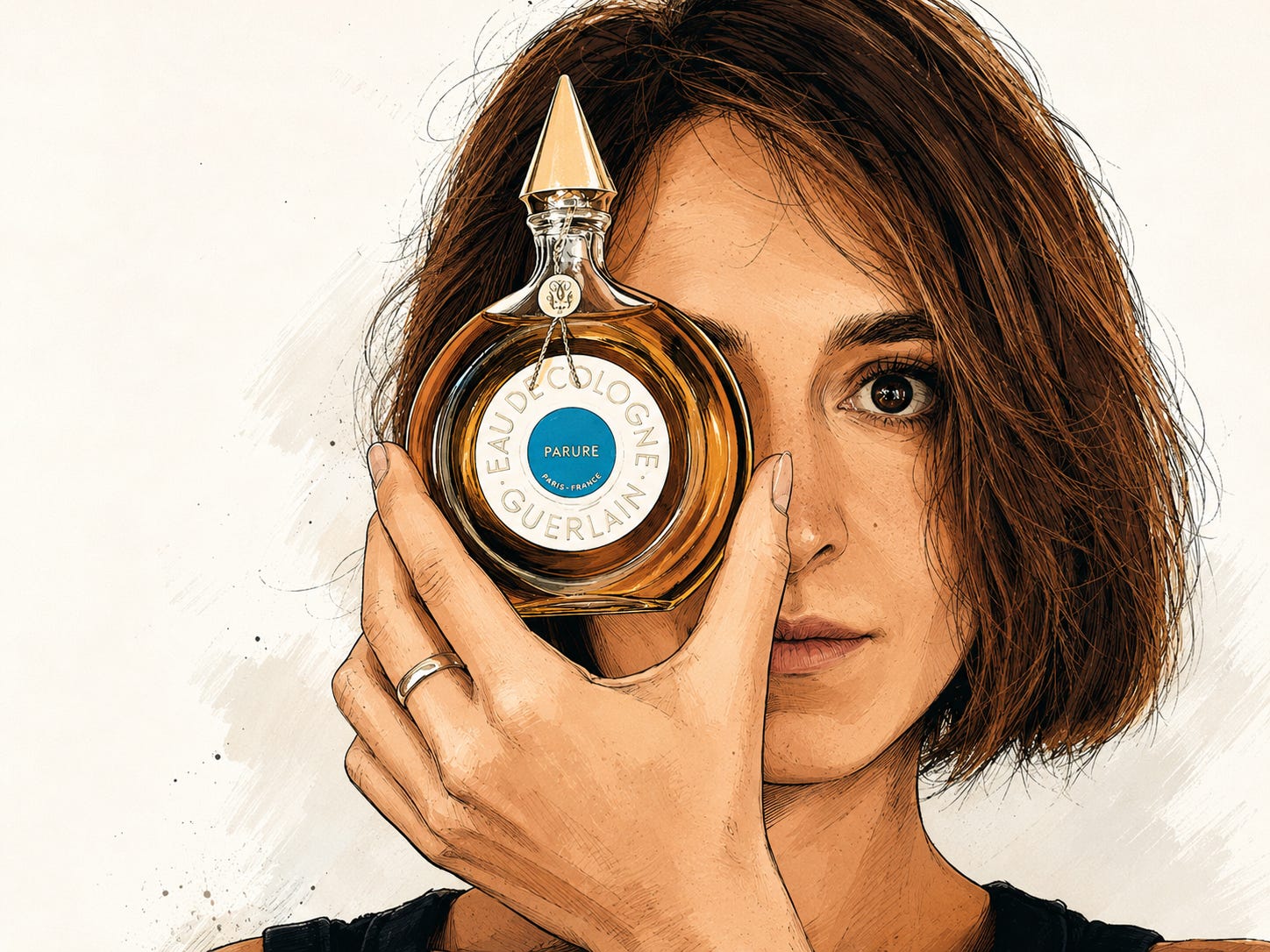
On July 21, Substack CEO Chris Best introduced a new word: Claudefishing. It is what happens when you read a text, give it your attention, and discover that there is nobody at the other end, the text was generated by AI. He titled his piece “Against Claudefishing.” That is why mine is called this.

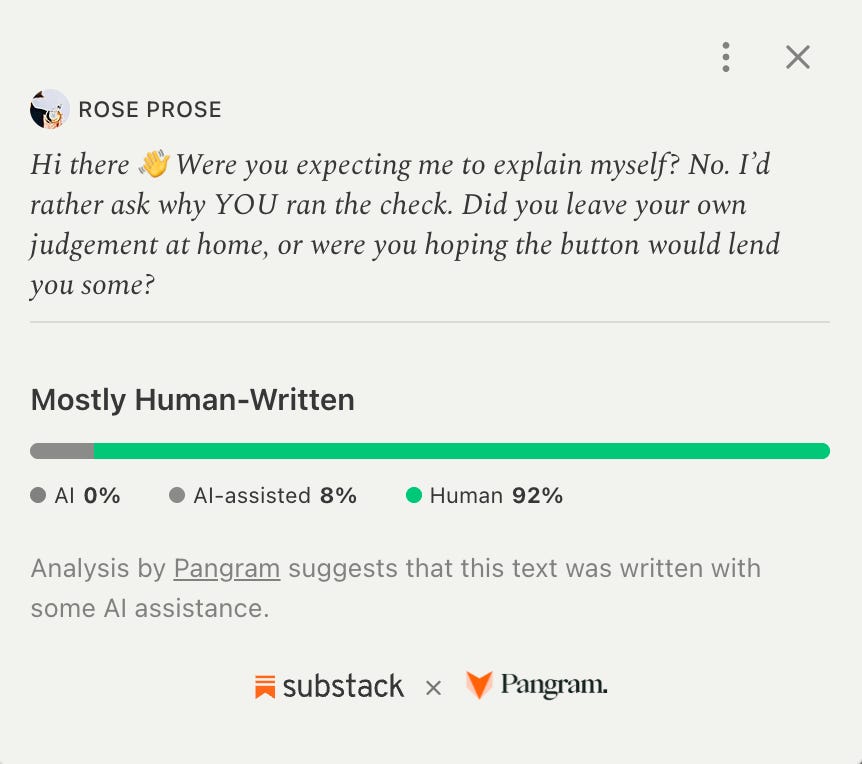
The solution he proposes is a button. You press it and receive three percentages: how much was probably written by a human, how much by a human using a machine, and how much was generated entirely by a machine. The analysis comes from Pangram, an AI-text detector.
But what does the button actually measure?
The problem Chris described is the absence of a person. What Pangram attempts to detect is the presence of a tool. If you think about it, these are orthogonal things.
And once you notice that, the question of the detector becomes uninteresting. In its place, another and much more difficult question opens up: if the author is not necessarily the person who physically produced the object, then who is the author, and where exactly are they located?
Perfume has been answering this question for more than a century.
The instrument
A gas chromatograph, a mass spectrometer. You feed it a sample of a perfume and receive a map of its volatile components: peaks, substances, relative proportions. Here is oakmoss. Here is peach lactone. Here is bergamot. Here is a jasmine base.
Let me say this immediately, so I do not look like a Luddite in your eyes: this instrument changed perfumery more profoundly than any individual perfumer ever did. It makes it possible to clone successful launches, reformulate perfumes around one new IFRA restriction after another, identify counterfeits, and reconstruct discontinued scents. It is incredibly precise at measuring what it is capable of measuring.
It can measure composition.
But composition is not authorship.
A chromatograph cannot distinguish Mitsouko from an extremely diligent reconstruction of Mitsouko. Similar peaks, similar proportions. But one bottle is Jacques Guerlain in 1919, with Farrer’s novel in his head: a woman silently waiting for the outcome of a battle that will determine the fate of two men at once, her husband and the man she loves. The other is: “Let’s make a copy of Mitsouko and present it as an innovative project”.
To the instrument, they are very similar. To perfume enthusiasts, they are not. And the difference will not be found in the materials used.
Since we are talking about materials, countless lances have been broken in the industry’s debate over natural ingredients versus synthetics. As though something depended on it.
It does not.
Perfumery is equally capable of producing magnificent and terrible things from either kind of material. I could not care less where a molecule came from if the result is good.
So this is not a column defending synthetics, nor is it another round in that war. Quite the opposite: that war and the current argument about AI on Substack are the same mistake. In both cases, the origin of the raw material is mistaken for a property of the work.
But authorship is not an ingredient. So where is it, then? I have at least four propositions about this. None of them is chemical.
Number Five
According to the best-known version of the story, Ernest Beaux brought Coco Chanel two numbered series of samples: numbers one through five, and numbers twenty through twenty-four.
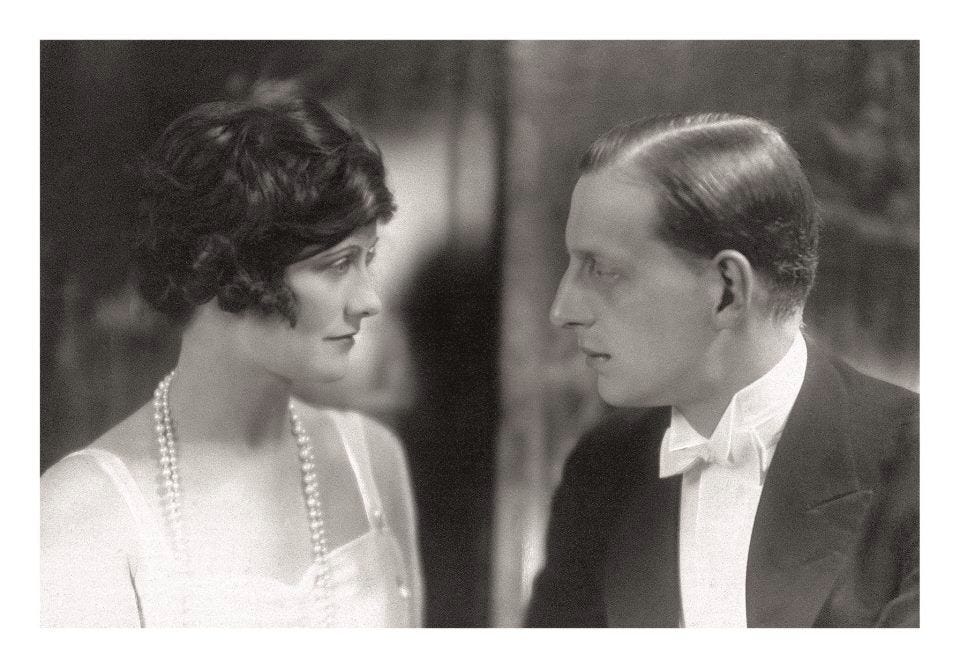
She chose number five. We still know its number. Nobody remembers the others.
But besides the samples that reached Chanel, there were also modifications that Beaux decided not to show her at all, discarded because they were too conventional, too heavy, too banal, or simply not right, and therefore never left the laboratory.
A chromatograph can tell you what Chanel No. 5 is composed of. It will not be able to find the other samples he threw away before the meeting. Nor the moment in time when Chanel said, “this one”.
But the act of authorship, perhaps, took place at that very moment.
We tend to think of the author as the person who physically produced the material: who wrote the words, made the formula, mixed the paint, laid the bricks. Some creative work unfolds in very different ways. It needs someone to set a vision, another to identify possible paths, someone to spot the right one. One person to say “no” 99 times, then someone to notice the 100th.
None of those microdoubts or microdecisions make it to the surface of the completed work.
That is my first hypothesis: an author is someone who chooses. And choice is invisible in the final product.
Between Lutens and Sheldrake
My second proposition is potentially even more unsettling. The authorship has outgrown the single person.
Christopher Sheldrake and Serge Lutens worked together for more than thirty years. Lutens’s name appeared on his bottles. Sheldrake created the formulas, sometimes together with other perfumers.
This is never clearer, perhaps, than with their debut scent, Féminité du bois. Lutens was the creative director of Shiseido at the time, and for years had dreamed of bottling cedar, the aroma of freshly felled wood he remembered from his childhood in Marrakech. Shiseido gave the project to Pierre Bourdon.
Bourdon drafted a beautiful dry construction of cedar with plum and apricot. The formula then migrated to his colleague, Christopher Sheldrake, who refined and developed it in collaboration with Lutens, creating a version that was darker, greener, drier, more translucent.
The bottle was designed by Lutens. On the bottle, it said Shiseido.
Who is the author of Féminité du bois?
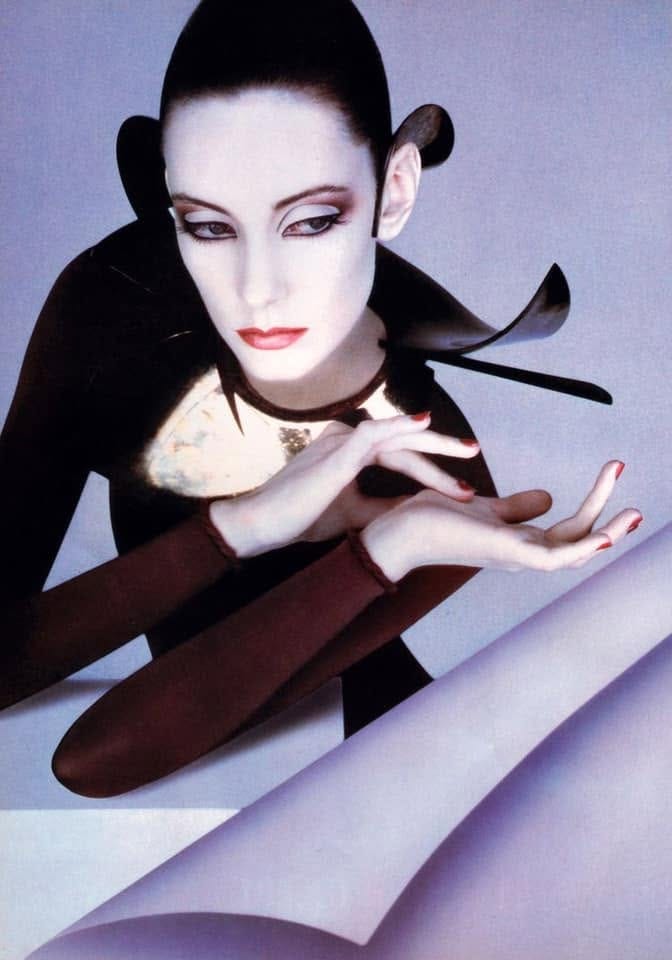
One could argue it’s Bourdon: the initial accord was his genius move. Or maybe it’s Sheldrake: an accord isn’t a fragrance, and he polished and perfected it into one we adore.
But it also must be Lutens, whose vision of cedar, whose insistent “No, not enough trees, I want more forest!”, sparked and guided the whole thing. All of them can say, yes, it was me.
And then it becomes even more interesting. Lutens and Sheldrake worked together using the same fundamental accord as the starting point for other perfumes over 17 years: Bois de violette, Bois et fruits, Bois et musc and Bois oriental — this time without Bourdon. Seventeen years later, Féminité du bois moved into Lutens’s own brand and appeared on a shelf under his name.
So an accord invented by one person was developed by two others, multiplied without the first, launched under a corporation’s name, and eventually signed with the name of the third.
Now try expressing that in percentages.
And yet neither Lutens with other perfumers nor Sheldrake with other art directors ever produced exactly the same world. Lutens without Sheldrake remains Lutens. Sheldrake without Lutens remains a great perfumer. But the dark, frightening and seductive universe they built over thirty years existed specifically between them.
Something very similar seems to be occurring right now with Marc-Antoine Barrois and Quentin Bisch. Barrois can offer worlds, imagery and the emotional backdrop against which the fragrance will live. Bisch can then translate those into scent.
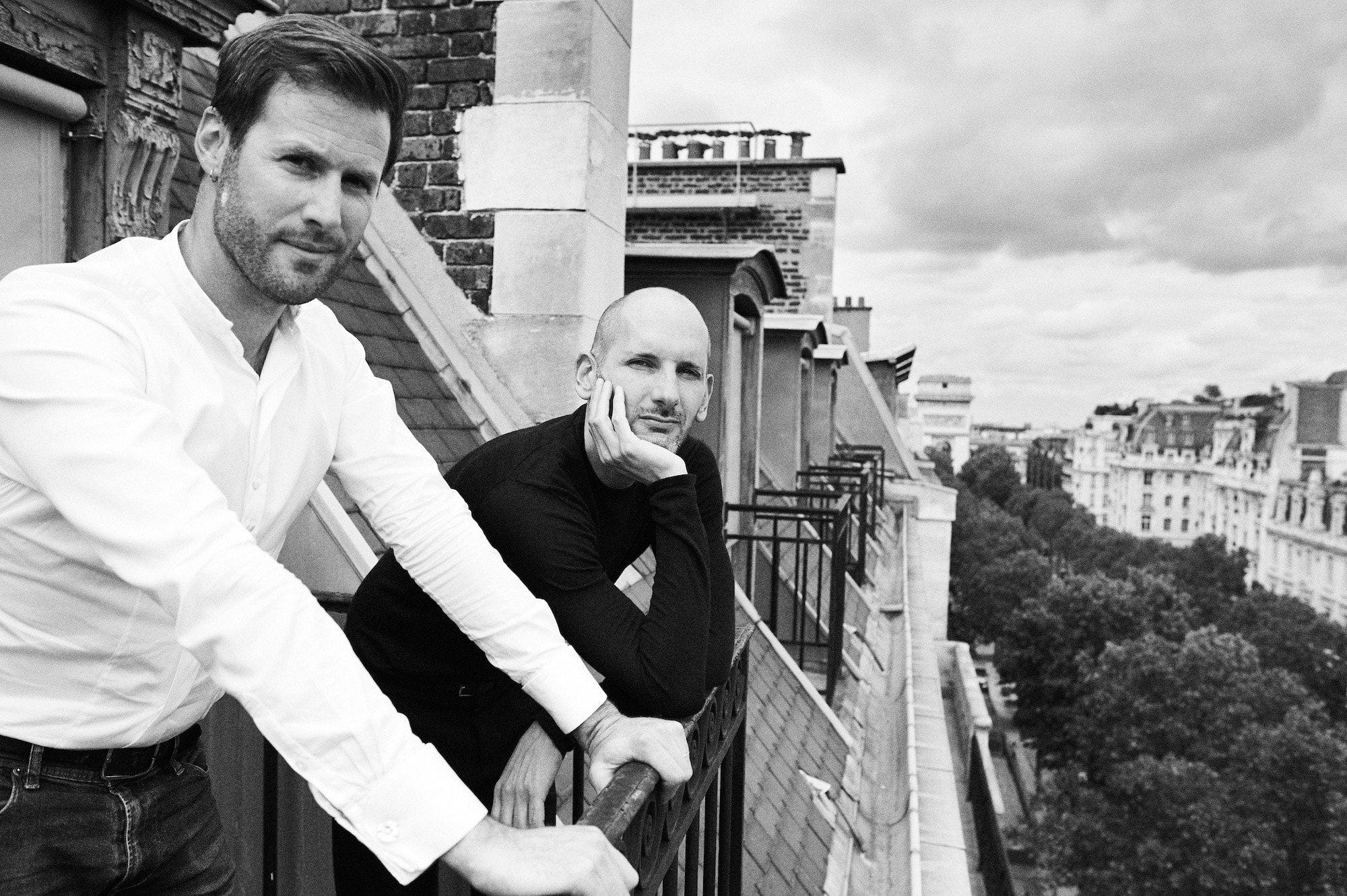
The entire line up of creations from Barrois’s house is born from their ongoing dialogue.
Barrois could work with dozens of other perfumers. Bisch works for many other brands. But Ganymede, B683, Encelade, Tilia and Aldebaran form a language of their own, one that cannot be found in its entirety either in Barrois’s other projects or in Bisch’s other work.
That language is not always close to me. Sometimes my nose struggles to tolerate it. But it is impossible to deny that it is new, coherent and instantly recognisable.
So who is the author of Ganymede?
I think the answer is both of them. But not fifty per cent each, and not because each person placed his half inside the bottle. Their partnership is not the sum of two contributions. It is a creative symbiosis that produces a result neither of them could achieve alone.
Maybe Barrois and Bisch are the Lutens and Sheldrake of our time. Who knows. In both cases, the primary author turns out to be the relationship between two people.
Why a perfumer needs an art director
There are brands where the question of authorship appears simpler.
Marc-Antoine Corticchiato creates the perfumes of Parfum d’Empire himself and decides what his house will be. Liz Moores does the same for Papillon, Hiram Green for his eponymous brand, and Andy Tauer for Tauer. Here, the perfumer is simultaneously the art director, editor-in-chief and face of the brand.
Such houses can be beautiful and successful, but there are surprisingly few of them.
Maybe that is because composing a scent and understanding which scents should exist within the same world are not the same skill. A perfumer may create a magnificent formula, but that does not mean they know how to build a business. Someone still has to decide which good formula should be released, which perfumes belong beside one another, what belongs to this brand and what — however beautiful in itself — would destroy its language.
What to call it. How to present it. How to sell it. When to stop.
Corticchiato, Moores, Green, Tauer and the other, relatively rare, successful examples seem to me proof of how unusual it is to find a person capable of doing both jobs.
That leads to my third proposition: even an “auteur house” does not mean one person made everything with their own hands. It means one person had the final word.
Who gets the name
The fourth hypothesis is not even about creativity. It is about convention.
Tom Ford trained as an architect, and in his perfume line he uses an architectural model of attribution. A building carries the architect’s name, even though the architect did not lay the bricks, install the windows or run the wiring. The architect’s work consists in making the labour of many people answer to a single decision.
Tom Ford fragrances are sold primarily as works by Tom Ford. The person who physically assembled the formula often goes unnamed even on Fragrantica. Ford’s talent in perfumery lies precisely in choosing the right person, setting the task, and drawing from very different perfumers a result that is then unmistakably legible as Tom Ford.
Frédéric Malle chose another model. He calls himself a publisher and the perfumers authors. Their names appear on the bottles.
Malle gave perfumers their credits, but that did not make him disappear from the work. He chooses the author, discusses the concept, rejects certain modifications, and walks away from almost-finished perfumes — whatever he may say in interviews about unlimited creative freedom.
It is a classic literary arrangement: the perfumer writes the book, Malle edits and publishes it.
Even the bottle design works as a system of credits. Malle’s black panel, pale cursive and red capitals look remarkably similar to old Rochas labels. But Malle seems to reverse their hierarchy: on Rochas bottles, the perfumer’s name never appeared on the front at all; on Malle’s, it stands at the top, the fragrance name sits in the centre, and Malle’s own name appears below, almost like a publisher’s imprint.
Edmond Roudnitska’s Le Parfum de Thérèse was part of the house’s first collection, so it is extremely tempting to see this as a deliberate quotation of Rochas, the house with which Roudnitska’s history was so closely connected.
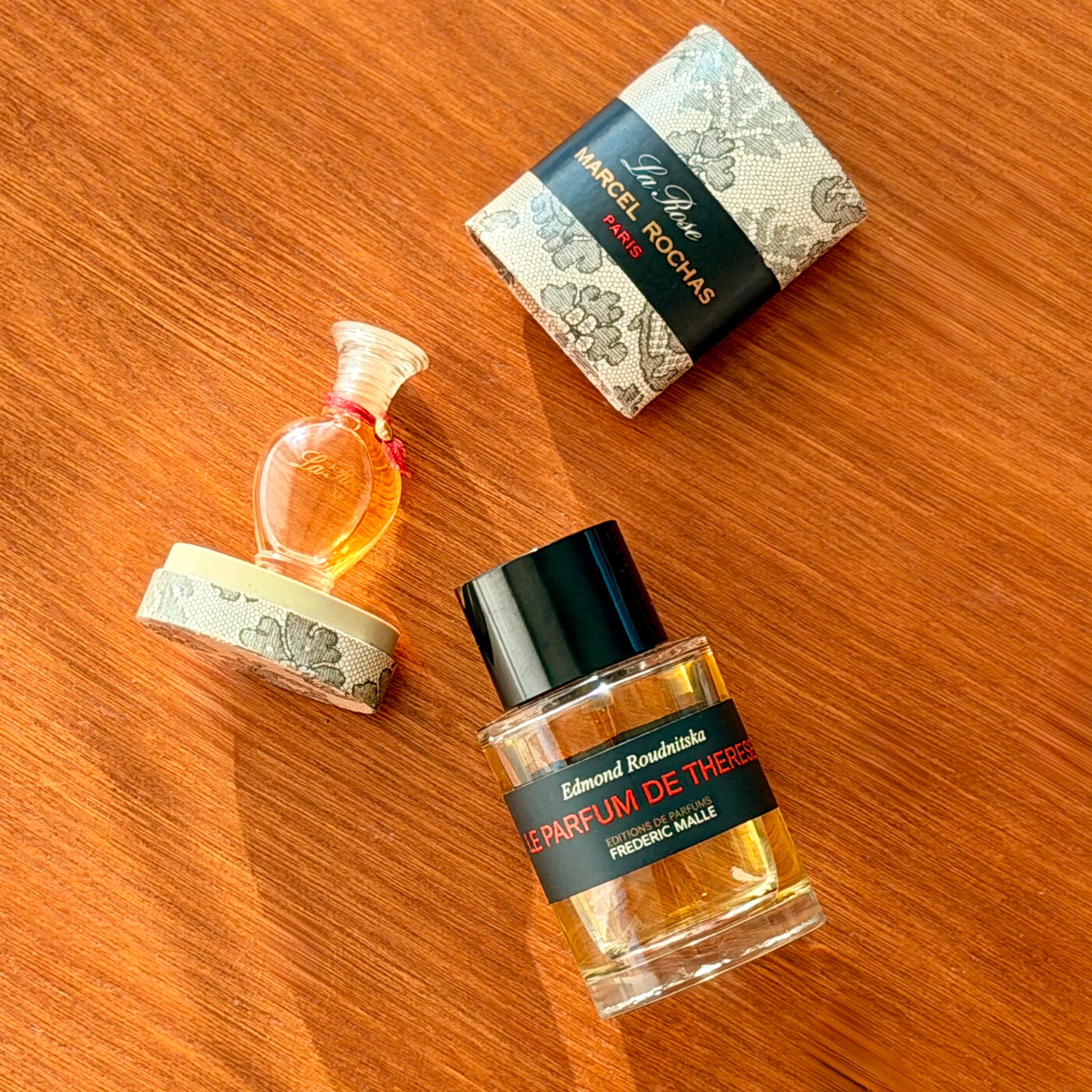
It would make a small essay on authorship printed directly on the bottle.
Chanel uses yet another model. The house has an official in-house perfumer, today Olivier Polge. But Chanel’s laboratory has never consisted of a single person.
Christopher Sheldrake worked first alongside Jacques Polge and then alongside Olivier. He joined Chanel in the mid-2000s while continuing to create perfumes for Lutens, which meant that, for a time, he was an author in two houses at once, under two different names that were not his own.
Officially, the author of modern Chanel fragrances is Olivier Polge.
And yet I sometimes think I can hear Sheldrake in some of them. Especially in Le Lion, with its dense, dark, almost Lutens-esque construction. This is my hypothesis, and it may be completely wrong. I have no document stating: here Sheldrake proposed the foundation, here Polge changed the proportions, here they selected the final modification together.
The bottle does not tell us either. A chromatograph will show labdanum, vanilla and patchouli, which is also fairly useless in this case.
The name on the bottle is not the result of chemical analysis, it is someone’s decision about how the work should be read. At Serge Lutens, Sheldrake was hidden behind the name of an art director. At Chanel, he may be hidden behind the name of another perfumer.
What I call mine
The four theses above concern other people’s work. Since authors are now being invited to publish explanatory statements about exactly how they work, here is mine.
1. I do the smelling myself. On my own skin, not through descriptions on websites. If I write that a dry bitterness emerges in the sillage during the third hour, it means I lived with that fragrance for three hours. The machine cannot take my nose away from me yet.
2. The associations, memories and comparisons that occasionally embarrass me afterwards are also mine. They are the main product. A blog about scent is someone else’s nose being used as an optical instrument. There is no universe in which I lend my nose to somebody else to wear.
3. Knowledge is more complicated. I have spent many years reading about perfume: books, blogs, interviews, forums, archives and articles. Some things I remember precisely. Some the machine finds faster. Sometimes I know a fact but no longer remember where I encountered it for the first time.
“Ernest Beaux brought Coco Chanel two numbered series of samples: one through five and twenty through twenty-four...” That can be checked.
But it is sometimes impossible to establish where a particular idea of Mitsouko entered my head. If I know whose idea it is, I name the author. But I cannot promise that every thought has emerged inside my hermetically sealed head and had never occurred to anyone before.
Nobody can. I can see how closely Malle’s labels resemble old Rochas labels, but I do not know (and probably neither does Frédéric himself) whether this was a quotation, a homage, or a memory that returned without its source.
4. When I write in English (it is my third language), the machine sometimes helps me with it. It may suggest a word, rearrange a sentence, or notice that I have lost an article again. It may even translate an entire passage that I wrote in my native language because that was easier for me. If I ever have nothing to say about a fragrance, I will not ask somebody else to say it instead, I simply will not write the post.
That, I think, is all the ethics required here. Not purity of origin, but responsibility for the result.
The wrong scale
Now I can return to the button.
You can use AI and leave more of yourself in a text than someone who typed every word by hand. You can generate nothing and write a completely lifeless text. You can ask a machine to propose twenty versions, reject all twenty, and only on the twenty-first finally understand what you wanted to say yourself. The detector will see traces of the first twenty, it will not see that they went into the bin.
In that sense, the comparison with a chromatograph is almost too flattering to the detector. A chromatograph at least directly registers substances. Pangram just makes a probabilistic inference from features of language with some claimed precision and recall.
But even if it guessed correctly, it still answered the wrong question.
Where nobody wrote the text at all, e.g. on slop farms producing hundred posts a day, the detector catches exactly the thing it was built to catch, and that is useful. But I do not want a garbage filter to be sold to me as an instrument for establishing authorship, because “AI was used here” does not mean “there was no author here.”
Just as the presence of Sheldrake does not imply the absence of Lutens. The hands of Ernest Beaux do not imply the absence of Chanel. Bisch’s name does not erase Barrois’s participation. The perfumer’s name on a Malle bottle does not erase Malle’s own role. And the fact that Tom Ford did not personally mix the formula does not prove that the resulting fragrance is not his.
Creative work does not add up arithmetically.
Authorship is not a solution of two components that can be poured into three columns: human, human with machine, machine.
Sometimes the person is located not in the words that remained, but in the ones they threw away, or in a conversation lasting many years, after which it is no longer possible to know who first had the idea, or in a single “no” that transformed somebody else’s entire work…
Sometimes in the decision to choose the fifth sample.
Chris Best ends his piece by saying that when he needs Claude’s opinion, he will ask Claude.
Fair enough, and I would say the same thing, but the button merely looks for traces of a tool in the result.
The wrong place
On the same day, Substack gave authors a second thing: the ability to write about how they work. These could have been our credits, but look at where Substack placed them: beside the scanner’s verdict. In that location, they cease to be credits and become the explanatory note of a schoolchild who failed to hand in their homework. That is why mine is demonstratively sarcastic. I am not going to take the position of someone proving their innocence.
Credits appear at the end of a film because the director decided they would. Roudnitska’s name appears at the top of the bottle and Malle’s at the bottom, in the publisher’s imprint, because Malle decided it like that. That label functions as a statement about authorship because its hierarchy is established by the publisher, not by an inspector.
Placement inside the object is part of the statement. It belongs on the author’s page, or in the publication’s About section, or in an optional footnote at the end of a post. But it should live where the author chose to put it themselves, and not somewhere they were forced to defend themselves.
Perfumery has never established authorship systematically. Malle brought perfumers’ names to the bottles. Ford signed perfumes he did not mix, as an architect signs houses he did not build. Chanel signs as a laboratory. None of these methods measures anything, and none corresponds to an objective proportion. Each one declares how the object should be read and appoints the person who takes responsibility for it.
And none of those signatures appears beside the result of an external examination.
Get the chromatograph to run. It will say Chanel No. 5: peaks, molecules, and ratios. All of what was left. The rest is not in the bottle.
Not the four samples Beaux brought alongside the fifth. Not the ones he decided not to bring at all. Not the second in which Coco said: this one.
The detector sees the text that survived, but true authorship most often remains in the wastepaper basket.
In the end, authorship is the signature beneath what remained.
This is so well thought out, researched, and presented. It is thoughtful and logical and kind. I agree with you completely and WISH more people would just.. be open and curious enough to take the time to LEARN and understand what it means to use AI in writing. It is a spectrum, not a definitive static point. For what is worth I've re-stacked it. Thank you for taking the time to write this.
I am a cinematic writer, so AI helps to fill in the in-between for me. Even if I go back to read it and rewrite, because, let's face it, AI makes mistakes- we all do. If it's not in my voice, I scrap it and restart, fixing words. Then you bring it to Substack or anywhere to publish your chapters, and you are curious what the AI detector says, and it's 100% AI. Excuse me, did AI make my Aria Valerius or Jason Mendoza? No, I did. I ran my work through a recent chapter, and "As I" was the only words that were not AI-generated. I worried over so many things. But thank you for this article bit of information that sits inside my chest at the end of the day, wondering if I should just throw away everything and never let my world out.