
Night Mail
Some things still make it through the dark. The people who carried them often don't.

— There’s some package for you. A small one.
— Probably from work. They were sending us gifts, I chose a watch strap.
— It doesn’t look like a watch strap.
— We aren’t expecting anything else.
I was typing something intently and answering without looking. My husband stood there with the package in his hands and conscientiously reported the situation to me as it unfolded, while I, with the complete confidence of a person in possession of the facts, explained to him that we hadn’t ordered anything.
— It says Guerlain here.
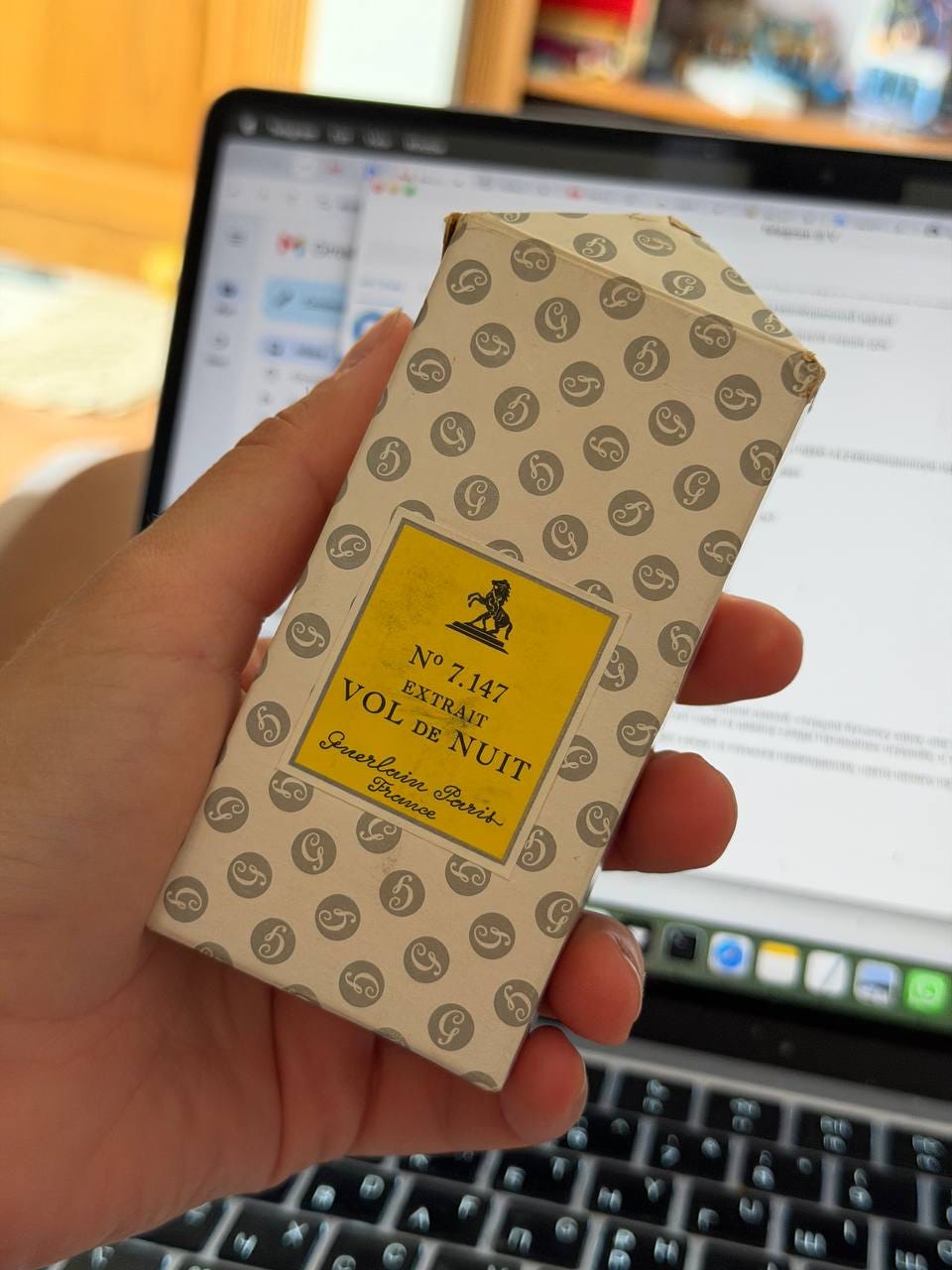
He handed it to me. I saw beige cardboard with dark speckles and the letters G. Coffee beans. Guerlain packaged things this way from the early sixties until sixty-seven. Then came the black-and-white zigzags, then then batch codes appeared, and dating became precise. Before that, everything was by boxes and the markings on the bottom.
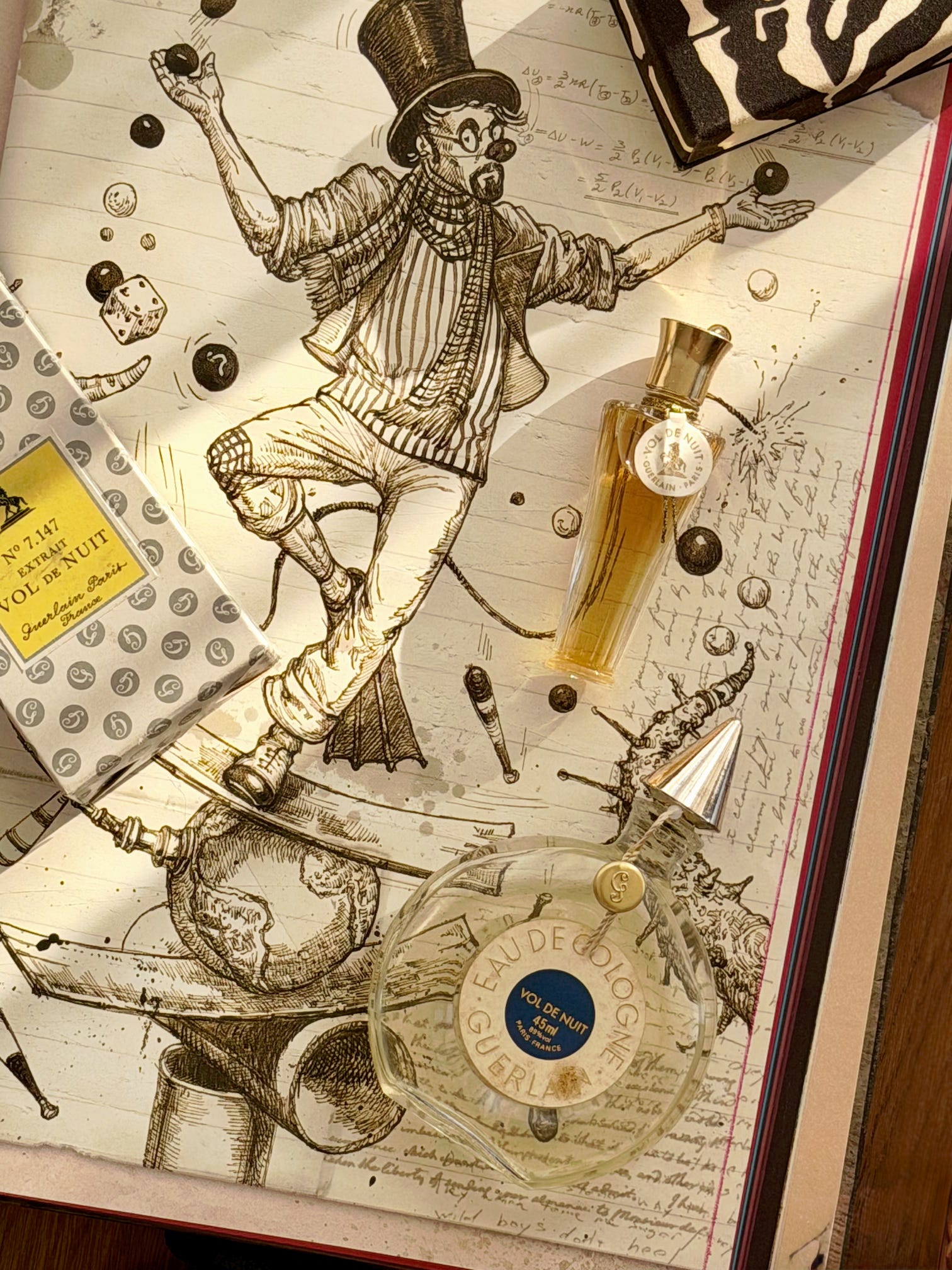
Inside was Vol de Nuit. Extrait. The umbrella bottle. If you turn it upside down, it becomes a little circus: the dome at the bottom, the neck in place of the mast. The condition is such that you want to speak in a whisper. A little over a hundred dollars on Japanese eBay. For a specimen like this, that isn’t a price. I don’t remember buying it. At all.
What if we go home?
On the third of July, we had the premiere of the film about the Chișinău circus. Four years ago, we were living in Vilnius. There was a war. I came across a photograph on Facebook of the bus stop near the house where I grew up. I showed the photograph to my husband and said:
— What if we go home?
And we went.
My husband was slowly putting himself back together; the war had taken away his homeland and his work in a single day. And I said: make a film about our circus. Not about the collapsed ceiling and the unique building of Soviet Brutalism — tonnes of that had already been filmed. About sawdust and popcorn, about flying beneath the dome, about the sweet and frightening way your heart stopped when the lights went out. About laughter — kind, tender, childlike.
At some point he posted several photographs, and hundreds of people responded. Literally hundreds, I am not exaggerating. And every one of them told their own story — kind, tender, childlike. People brought photographs, old posters, stories, grievances, favourite quotations. It became clear fairly quickly that it was impossible to make a film about the circus that was only about the circus.
On the third of July, we showed the film in the courtyard of the National Museum of History of Moldova. More than five hundred people came. Chișinău sat beneath the open sky and watched a film about itself. A phrase spoken in a kitchen in another country had somehow made it all the way there.

We came home completely destroyed. Opened a bottle of wine, drank a glass each. My husband said, “I’ll cut some cheese.” He didn’t make it to the kitchen, sat down on the sofa and slept until morning. I don’t remember anything either. Not how I gave up waiting for the cheese, not how I decided to distract myself and look at eBay, not how I came across Vol de Nuit at all and pressed the “buy” button.
The perfume I didn’t love
And now the funniest thing: I never loved Vol de Nuit.
Several years ago, I wrote a post about it in which I called it my least favourite classic Guerlain. It was a great disappointment to me because I never understood what the author wanted to say. It infuriated me that the opening was brilliant and then everything deflated. This is what I wrote about the opening then: “bitter, sharp, juicy, green... you feel like an infinitely happy horse with its muzzle in a spring meadow after a long winter in the stable.”
I still think this is the best thing I have written about galbanum, and at the time it seemed to me that Jacques Guerlain lost his nerve a little after that. Irises, narcissus… and down into vanilla-sandalwood sweetness. “As though he had been thinking of making the perfume a chypre, changed his mind on the way and went into a woody oriental, fatal passions.”
Fourteen years later, Germaine Cellier would take exactly this razor-edged galbanum for Vent Vert, and an entire direction of green chypres would grow out of it. That is, Guerlain had the idea first, but he did not dare carry it through to the end because it was too unlike himself.
But taste changes without asking and does not send you an updated version of your personality for approval. One day you simply discover that everything has already changed.
In my case — literally. My hand ordered the perfume that my head did not love, on an evening my head remembers nothing about.
Two darknesses
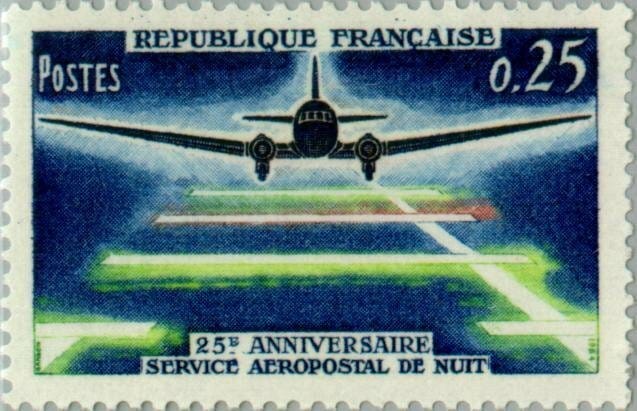
Vol de Nuit came out in 1933. Saint-Exupéry’s novel — two years earlier. Jacques Guerlain read the book, and something struck him so deeply that instead of yet another garden, flower or woman, he decided to dedicate a perfume to a night flight.
I like the gesture itself.
One person writes a book about pilots carrying other people’s mail through the darkness. Another reads it and responds with a smell.
So, I used to think that Guerlain lost his nerve after the galbanum, but now I think: perhaps he simply returned?
There are two darknesses in Vol de Nuit. The first is cold, piercing. The open door of a hangar, night at altitude, air cutting into your face. The earth has disappeared, nothing can be seen ahead, all that remains is to keep gaining altitude. Then the perfume descends: iris, narcissus, moss, sandalwood, vanilla. And another darkness begins — warm, woody, almost domestic. The night of a room where one dim lamp is burning and someone has not yet gone to bed.
One darkness replaces the other. This, in my view, is very Guerlain: to fly upwards, as high as you possibly can, see the cold stars, and still return the aeroplane to vanilla and sandalwood.
Three books about responsibility
I have a separate relationship with Saint-Exupéry.
I stopped loving The Little Prince at the same time I learned how to leave. As a child, it seemed like a book about love and loyalty. Now I see a fairly toxic story about why you must tolerate someone who hurts you. And then the fox comes along and delivers the basic basics for half the toxic relationships of the twentieth century: you are forever responsible for everyone you have tamed. Not great for a children’s book.
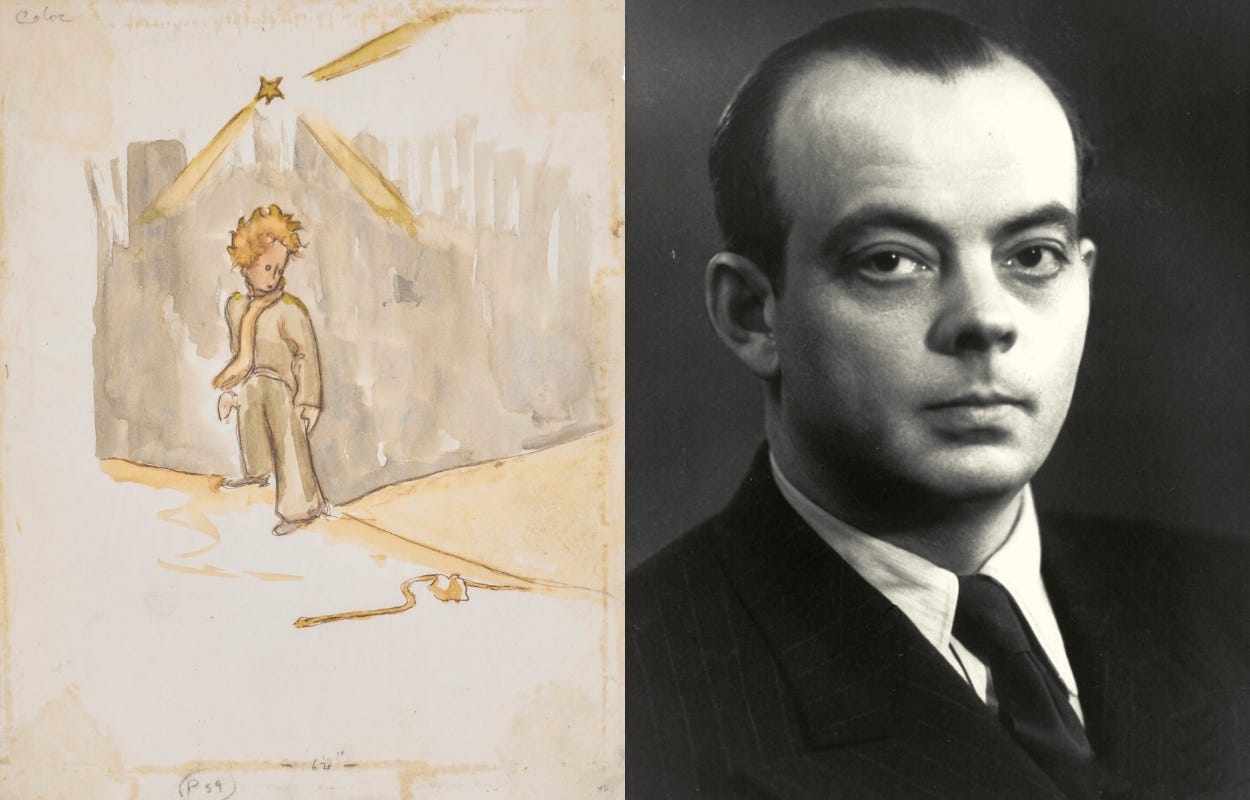
But Wind, Sand and Stars (Terre des Hommes) remains my favourite. Especially the ending; I can quote it almost by heart: a third-class railway carriage, Polish workers being expelled from France, compressed by life into lumps of clay, and among them a sleeping child with an impossibly beautiful face, the infant Mozart. But he is being carried to the same place, beneath the same stamping press.
Exupéry writes that it is not poverty itself that torments him. Something else is more frightening: in each of these people, perhaps, a Mozart has been killed. Talent and the possibility of becoming someone are methodically destroyed by work, exhaustion, circumstances, the absence of space in which a person might unfold.
Everyone admires the way Exupéry wrote this. And they are right to admire it.
But not everyone knows that a couple of decades later a clown came along and carried his thought to its conclusion:
Do not mourn the murdered Mozart. Do not let them murder the next one.
We will return to the clown.
Finally, Night Flight is a book about how the mail must get through. There is Rivière, the director of the air-mail network; he knows neither sentiment nor fatigue, and every day he sends people into the darkness. Rivière is not a villain. He believes in a cause greater than the individual, knows the price of flight and still believes that the price of inaction is higher.
And there is the pilot Fabien, who gets caught in a cyclone over Patagonia. Landing the plane is impossible. So he begins gaining altitude and rises to the very highest point, above the clouds, into a completely endless starry sky. The beauty is incredible; there is no fuel for the way back.
Fabien does not return. In the morning, Rivière sends out the next aeroplane.
The lowest genre
I once wrote in my old LiveJournal posts: the circus is largely about how people fight gravity and then come out to take a bow anyway. When I gave my speech at the premiere, this comparison came back to me.
The circus is simply literally built this way: most often, a person leaves the ground, stays up there for a while, does something incredible, and then comes down, wipes their hands on their thigh and bows. The audience exhales.
Ever since childhood, I have hated hearing the circus called low art. Especially clowns. The clown is often the most professional person in the circus. He must know how to move, fall, control his body, hear the music, hold a pause, see his partner, feel the audience and react instantly if the act goes wrong. But the clown is conventionally regarded as a low genre within an art that is itself already considered low. He is supposedly there to fill the pauses while the props are being changed for the real performers.
Western culture has plenty of sad clowns. Usually it is the same plot: the performance has ended, the spectators have gone home, the clown has been left alone, and now it becomes clear that he himself does not find it funny at all. This is sadness for oneself.
In the USSR, there was a clown of a completely different kind, Leonid Yengibarov. He was sad for others. The closest thing to him is probably Fellini with his philosopher on the tightrope in La strada.
Here is Yengibarov walking out onto the tightrope.
The rope is lying on the floor. See for yourself.
Leonid Yengibarov, “On the Tightrope”
When we began making the film, the clown immediately took charge of the philosophical part. Sasha Cojuhari. We have this entire line: Exupéry, Yengibarov, Fellini, the murdered Mozart, and it came from him. Sasha once said that Fellini dreamed of becoming a clown, but it was too difficult a profession, so he had to become a director. That is the hierarchy of the arts.
Do not trim the fountain
I read Yengibarov’s novellas when I was at school. They are not even stories; more often they are half a page, sometimes a page, rarely two. In that amount of space, an author usually only has time to establish the exposition. Yengibarov managed to build a world, overturn it and leave while you were still wondering whether you were supposed to laugh or cry.
In one novella, a man comes to a park with enormous scissors and trims the jets of the fountains. The water immediately returns to its place. He does it to show people: not everything in the world can be cut. Especially not with the same comb.
It seems to me that this is the entire essence of the clown: the world is constantly trimming someone to fit — a profession, propriety, the market, the state, an idea of a normal person. And the clown comes out with scissors to the fountain and shows how idiotic the very idea looks.
In another novella, first a man kisses a girl beneath a tree beside a river. Only afterwards do tribes, states, Olympic Games, wars, Auschwitz, freedom, geniuses, worlds and the entire rest of human history appear.
We constantly treat the large-scale as primary and the person as a particular case. Yengibarov puts everything back in its proper order: first one person reached towards another, and everything else came afterwards.
And it was he who answered Exupéry: do not hurt a person — perhaps they are Mozart and have not yet managed to write anything. Do not wait for proof of genius, do not rush to trim, break and explain their place to a person. Especially if they cannot yet prove in any way that they deserve mercy.
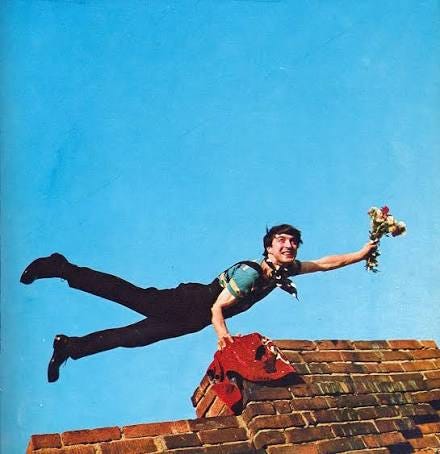
He also has a novella about a circus performer who spends a long time learning a handstand: his shoulders hurt, his wrists swell, his eyes fill with blood. Then he slowly lifts his second hand from the floor and realises that he is holding the globe on his remaining palm.
This is where the clown and the pilot meet. Fabien raises the aeroplane above the cyclone and finds himself among impossible stars. The acrobat raises the Earth on his palm. The pilot carries the mail. The clown carries us ourselves.
Self-portrait under someone else’s name
Yengibarov died at thirty-seven, of a ruptured heart, in July of seventy-two. A few weeks later, the Soviet bard Vladimir Vysotsky wrote the poem “To Yengibarov — From the Audience.”
I read this poem aloud in acting classes about fifteen years ago.
It contains the main lines:
He did nothing funny,
He took our sorrow upon himself.
This is the difference between the ordinary sad clown and Yengibarov’s clown: the first suffers when the spectators leave, the second — because they came. The audience places its sorrow on a person’s shoulders, laughs a little, cries a little and goes home feeling lighter.
Vysotsky wrote this about Yengibarov, but in essence it was partly a self-portrait. He himself lived another eight years in roughly the same way: his own sorrow, other people’s sorrow, a guitar, his own voice, other people’s voices, one more hall, one more entrance. The poem turned out to be night mail: he sent it to Yengibarov, and eight years later it returned to the sender.
At the end, Vysotsky admits that he invented the cap for Yengibarov himself: the real clown performed without one. And it is true, after death the production of symbols begins. We try to determine who he was, what he meant, which phrase or meaning of his life should be considered the main one. In essence — we draw in the cap.
The bow
In February, Sasha performed his one-man show. He was taken from the stage to hospital. In May, he was gone. He did not live to see the third of July. The circus is no kinder than night mail: a person rises upwards, sometimes does not come back down, and the audience does not always have time to applaud. We did not have to invent him entirely after his death, to draw in the cap. He had time to explain who he was himself, to quote Exupéry and Yengibarov, to joke about Fellini, to formulate the entire structure of the circus profession.

After a person dies, all that remains is to do the same thing Rivière does: send out the next aeroplane in the morning. Edit the film, prepare the event, gather people, give them a beautiful summer evening and a little return to childhood. This is not a victory over death. Art does not defeat anything at all. It cannot resurrects, it does not return time, it does not deliver applause to where a person is still capable of hearing it.
It simply does not allow a person to be completely turned into a date, a photograph and a correct speech. Sasha is in the film — alive, speaking, with an ironic squint, with this Mozart of his.
On the third of July, more than five hundred people applauded him. He did not hear it, but the bow took place anyway.
A room where someone was recently
Briefly about the smell now, because after all that, analysing the pyramid feels slightly indecent.
The first minutes — cold and green, that same meadow, a hangar at four in the morning. Then it grows warmer: iris, powder, a strange narcissus that always seems slightly spoiled — exactly like a living one.
Then everything goes downwards — moss, sandalwood, vanilla and that warm animal thing we all love so much in vintages.
After three hours or so, it is no longer a composition but a material. Wood, dust, warm skin. It smells not like a person, but like a room where a person was recently.
The bottle stands on my shelf. Sixty years old, an inverted circus dome, coffee beans.
It made it.