

He Never Painted It Like That
On vintage perfume, repainted Rembrandts, and falling in love with whatever the loss leaves behind

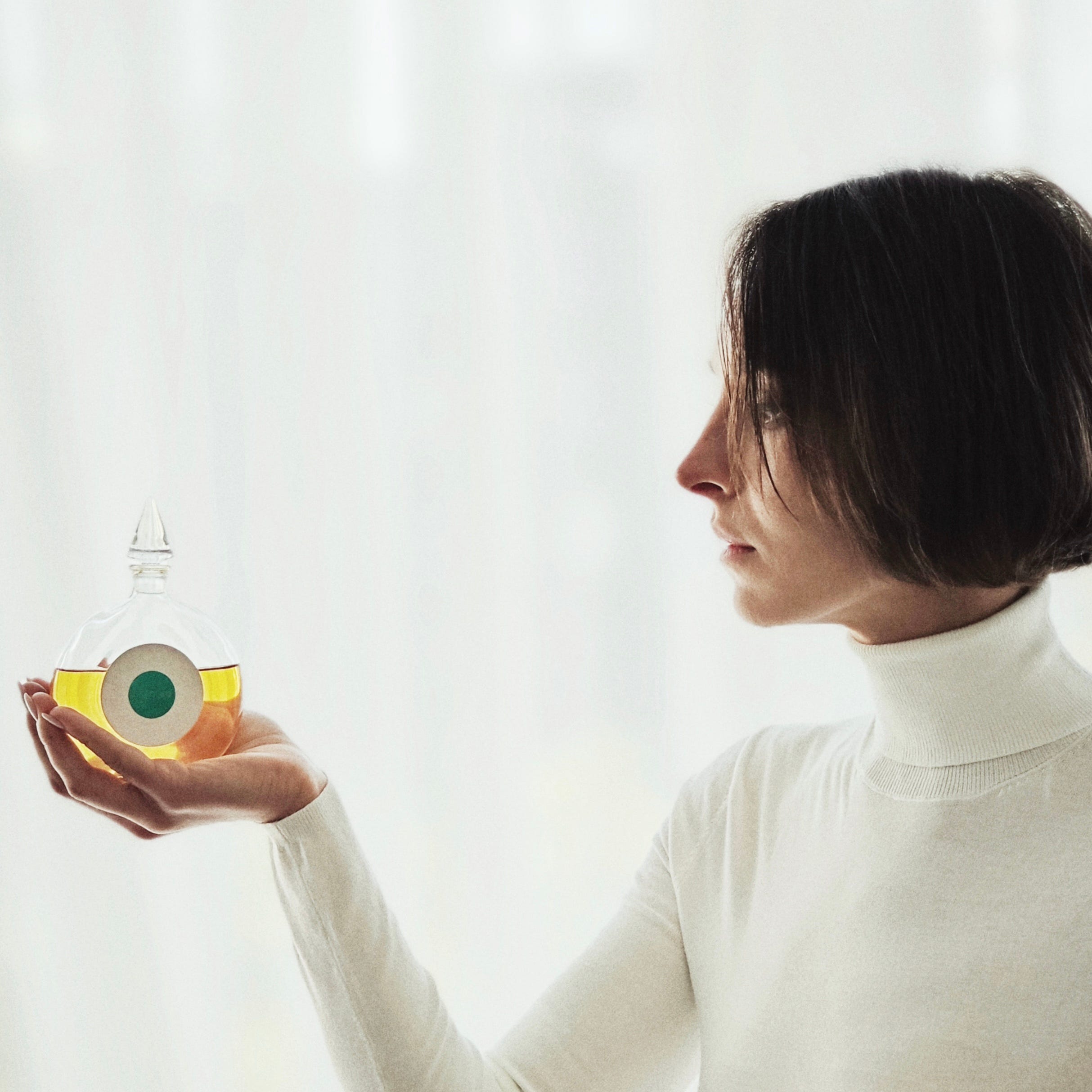
My husband fell out of love with painting in a single evening. He read how the old masters get restored, and something in him changed. “You do understand that almost everything we line up to see has been repainted? Varnish stripped, losses filled in, scrubbed down to a color no living eye ever saw. Leonardo’s hand isn’t in there anymore. We queue to admire the restorer.” Then he stopped going to museums.
That same evening I was bent over a parcel of vintages, working open a flacon with a crust welded to the cap, the juice gone the brown of old cognac, a little sediment asleep on the bottom, the label freckled with damp. I put a drop on my wrist and felt his exact feeling, only flipped inside out. He’d been betrayed by the cleanness. I’d been betrayed by the rot.
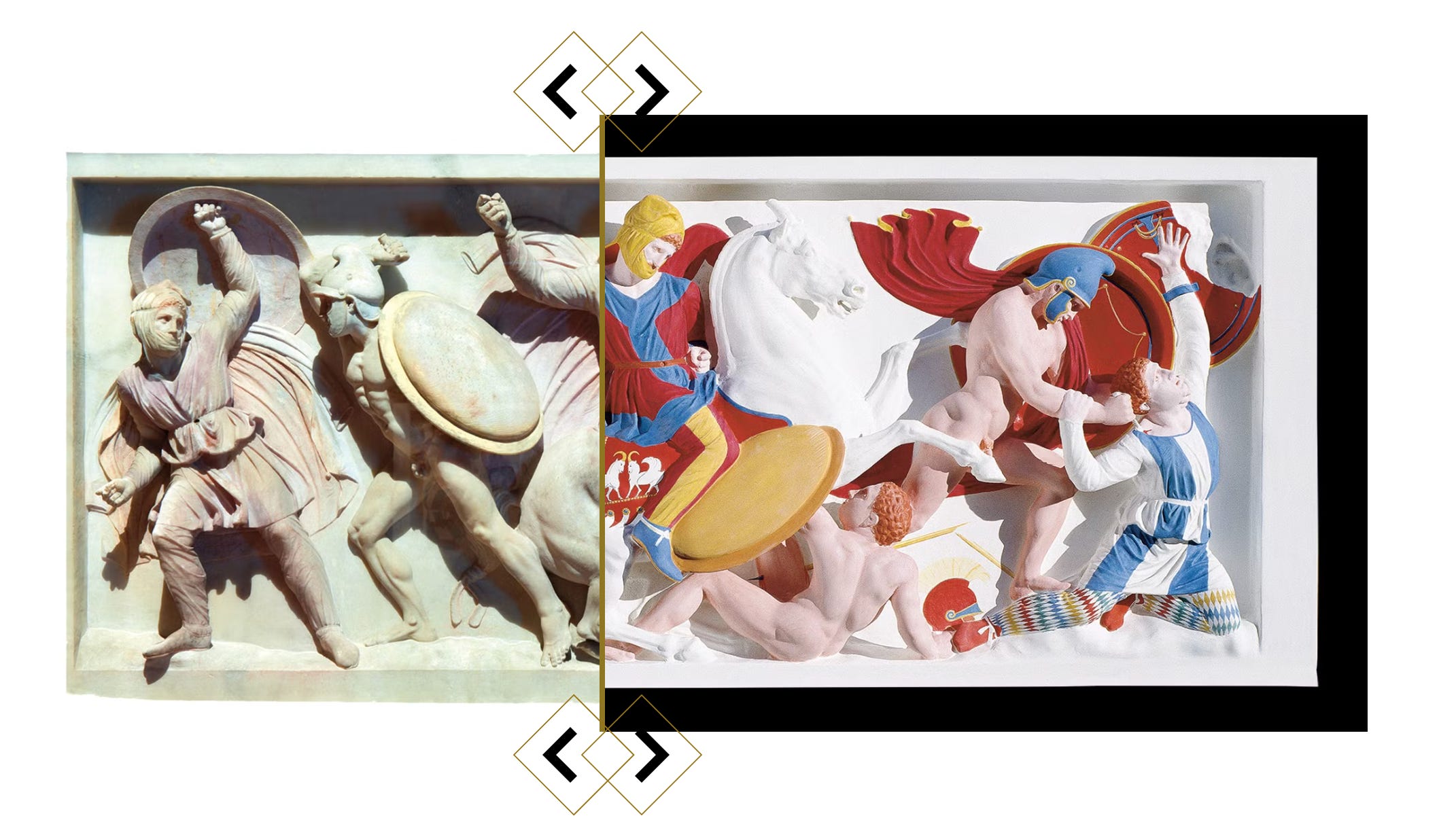
We all know the statues. White marble, the nobility of pure form, light triumphant over color, the whole of European sculpture rising from that one chaste root — and it’s a lie from the ground up. The gods of antiquity were painted, and painted without shame: scarlet lips, blue irises, gold leaf, a worked pattern running the hem, a fairground carousel where we imagine the hush of the Louvre. The pigment flaked off across a thousand years, the marble stood there naked, somebody influential decided naked was nobler, and we fell in love — all of us — with what was left after the loss. Our entire taste for white is a taste for damage.
And it doesn’t stop at marble. Black-and-white photography comes down the same line. So does every filter that drains the color out of an image to lend it “mood.” Tell a person the Parthenon was once daubed like a circus wagon and watch him flinch — it shouldn’t be that way, his heart simply knows better. The honest, colored original reads as vulgar now; the bleached fragment reads as profound. The error won so completely, and so long ago, that it stopped being an error and became taste. We don’t even remember it was ever otherwise.
We’ve unlearned the difference between a thing and its decay altogether. The crackle of a record is a defect, a fleck of dust in the groove, and we pay extra and call it warmth. Film grain is a failure of light, and we paint it back over spotless digital so the photograph will give off — forgive the word — authenticity. The faded snapshot beats the bright one. Rot became the synonym for soul, in everything, and we go on kneeling to it.
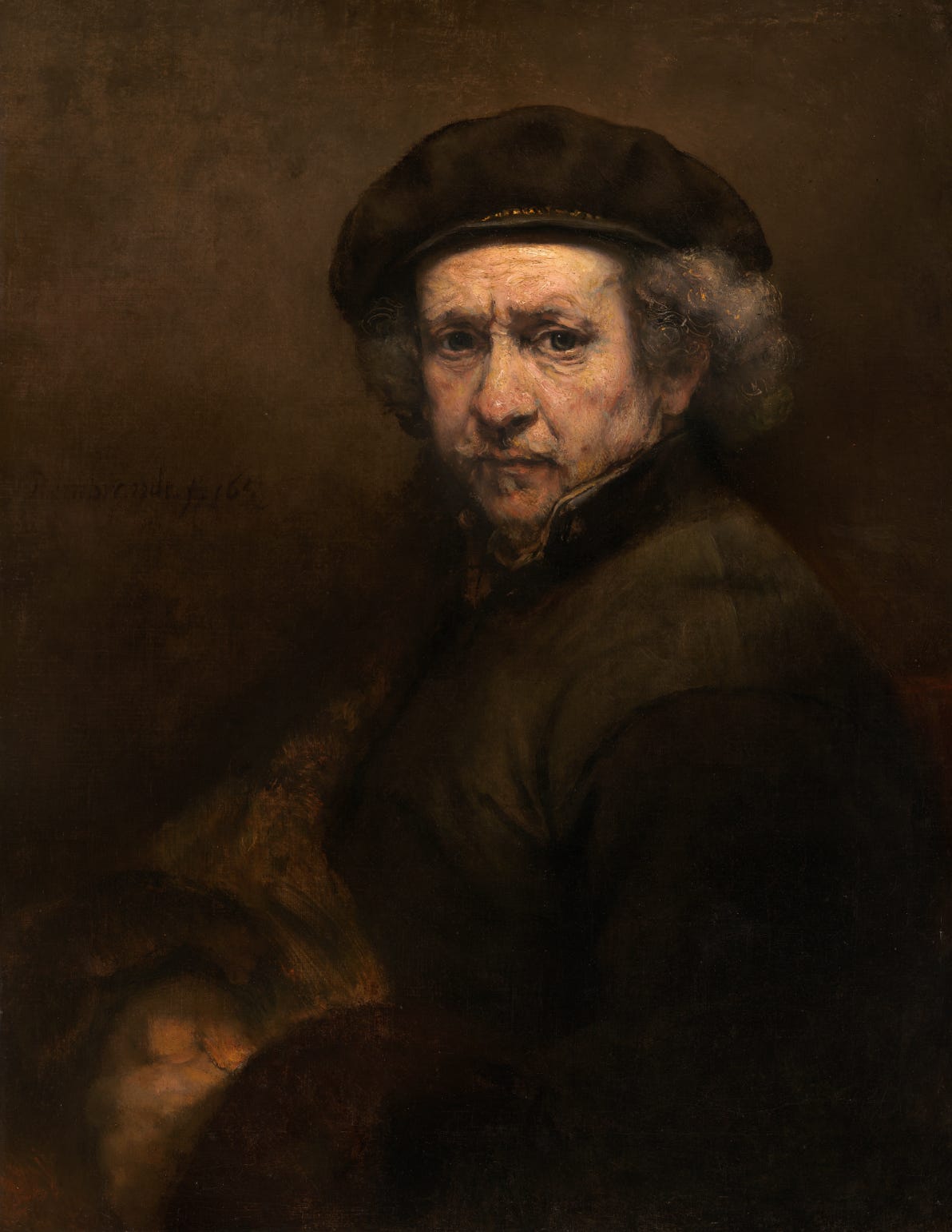
With paintings the swindle runs the other way. The restorer lifts off the soot and the amber varnish and the canvas ignites: depth, transition, a lamp suddenly switched on behind the paint. Anyone who’s met the same Rembrandt in two cities knows the small treachery of it. Here he is, warm, breathing under his patina; there he is, scoured until he glares at you — and the scoured one is the fake. Not Rembrandt. He never painted like that.
(The restorers themselves have been at each other’s throats for generations and still can’t agree what “right” even means. One school takes a canvas down to the ground; another swears the patina is biography and scraping it off is murder. Both are correct, which is the unbearable part. Two lawyers, three opinions, you know.)
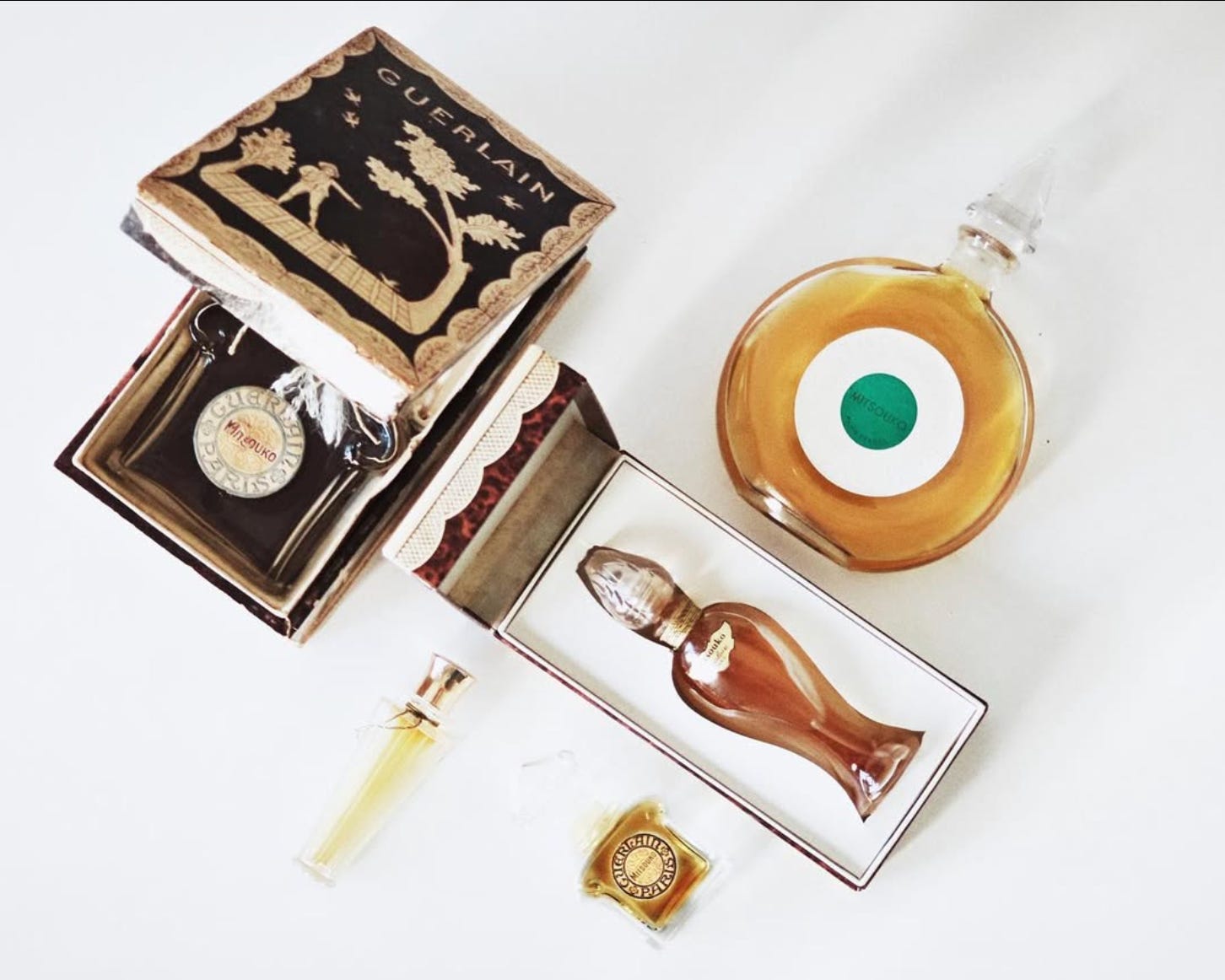
Vintage perfume obeys the very same law — we just agree not to say so. We treat the old bottles as benchmarks outside time, untouched, a golden age you’d better hurry and catch before it sells out. I’ve collected them for years and I still reach for a good flacon before I’ve decided to; the hand goes on its own. Nobody passes through this hobby clean — the classics take you down by the ankles. I can still feel my first: a bottle of Mitsouko from the 80s, bought from a collector, my fingers shaking as I lifted it. It smelled the way nothing is allowed to smell anymore — dense, heavy, gloriously out of fashion — and I decided on the spot I’d finally found the real thing. A time machine. A clean wire running straight back to when they still knew how.
Except the classics we’re smelling are not my youth. I never wore them then. I arrived late and were introduced to them already elderly — ten, twenty, thirty years spent in glass, in heat, in light, in some stranger’s cupboard outside Chisinau or outside Lyon. And a perfume at fifty is no longer that perfume. The accents shift, the notes mutate, something walks out of the room and never comes back; the top collapses first, the base swells and goes heavy, the whole balance drifts somewhere the author never planned. A chemist will tell you without flinching: your fragrance is dead, stop cooing over the corpse-bloom. And he’s right, the wretch, in his cold flat way.
But pour three vintage bottles of the same scent and you get three different perfumes — three tempers, three moods, three arguments. Which one is real? The best preserved? The loudest? The one that matches the old advertisement, which was lying too? The perfumer himself, hauled up out of his grave, would fail to recognize half his own children and take it as an insult.
And the long-lived ones aren’t only aged — they’re rewritten. Mitsouko has been alive more than a century, and across that century she’s been revised again and again: oakmoss gets outlawed, so out it comes and the base is rebuilt from scratch; taste softens, so the seventies spoon in extra flowers and comb that bristling peach-and-moss chypre down into something a gentler decade could wear. Jacques Guerlain composed one thing in 1919, and after that other hands took the brush, generation after generation, each correcting toward its own era. So three bottles from three years aren’t three patinas over one canvas. They’re three different canvases — and each of them, afterward, yellowed in its own private way.

Here is where the painting goes through me like a skewer. A restorer at least scrapes back toward the original; he believes there’s one down there and that he’s getting closer. The house is a restorer running in reverse. It doesn’t scrape, it paints over — freshly, to flatter today’s taste — and under the seventies’ paint there’s no 1919 canvas left to reach. It was painted over. The overpainting was painted over again. The original doesn’t exist even in principle: not buried under varnish but erased and re-authored so many times it’s become almost indecent to ask whose hand we’re discussing.
And memory is no help, rather an accomplice. You think you remember how it smelled in ‘95 on your mother, but memory works as a restorer too, touching up, trimming, filling its losses to its own taste, and there’s nothing left to check it against. The original survives neither in the bottle nor in the head.
The crowd, meanwhile, has settled the matter for you in advance. Sniff a current reformulation and the verdict lands instantly — a gelding, a watercolor of a copy, go smell the vintage, that’s where the soul lives. So you go hunting older glass, you break your nose against the darkened juice, you teach yourself to call the sourness “depth” and the muddle “character.” Today’s Chanel No. 5 against No. 5 from the eighties is good for a three-day brawl in any chat room, and the older bottle always wins on points. “It hasn’t turned, it’s opened up,” they tell you with a perfectly straight face. “Your nose just needs breaking in. Be patient.” And you are patient, and one day you really do begin to hear nobility where the vinegar used to be. It never once occurs to you that half of that famous depth is thirty years of oxidation — that the thing on your skin isn’t Guerlain’s intention but what air and time did after he left the room. We wear the patina and call it the soul.
And we pay for it like rent. A lot closes at insane money — top long dead, half the liquid gone to the air, a little silt on the floor of the bottle — and the bidding runs as if the Grail were sloshing inside. The deader, the dearer. It’s the logic of antiques laid over a substance engineered, from day one, to vanish into the air by the nineties. Somehow we’ve learned to sell evaporation.
And here my husband catches up with me again, Leonardo under his arm. They erased the time for him, and the master’s hand still wasn’t underneath. Nobody erased mine, and the patina lies so thick the master’s hand is gone under it anyway. Clean it and you lose him. Let it age and you lose him. The original is out of reach in both directions, and I honestly can’t tell you which loss is more honest.
The niche has gone off like a flare these last twenty years, self-taught makers everywhere. No long climb from junior chemist to house perfumer inside a conglomerate; instead a person falls for scent first, starts blending on the kitchen table, opens a label. Inspired by what? By vintages, which he too smelled already aged, already listing to one side, already nothing like what their authors meant. And he builds a whole world off those warped coordinates, for an audience of maybe one and a half people whose settings are warped to match. Liz Moores at Papillon, Hiram Green — self-taught to the marrow, and they conjure this noble rot so beautifully the whole room goes still. Dark, resinous, mossy, like the old days. Except the old days never smelled like that. That’s how the old days smell after fifty years on a shelf. A whole aesthetic is being born and we’re calling it vintage — not because it reproduces the old formulas (where would you even find them, and where’s the banned oakmoss, the real musk you only get in nightmares) but because it faithfully reproduces the formulas as time deformed them. The beauty of decay, mistaken for the truth, built into a canon. And the canon turns, predictably, and starts taking its revenge on authenticity.
The versions “recreated from the original formula” are exactly the ones the connoisseurs can’t stand. Not the same at all, they say. A completely different reading. Of course it’s a different reading — someone switched the lamp back on inside the canvas, and they’ve grown used to the soot, and they mutter: he never painted it like that. The reconstruction shows the intention honestly, and it loses to the decay, because it was never the intention we fell for. We fell for what became of it.
And the funny part is that the great houses are chasing the same ghost. Modern Mitsouko strains to smell like the Mitsouko of forty years ago; the house reformulates the perfume to resemble its own aged reflection, running after a phantom it produced itself by bottling the thing and leaving it in the light for four decades. The perfumer reduced to running errands for time. Time is the co-author now, and time collects the fee.
There is no past inside a vintage. It evaporated with the top notes in the first few years. Vintage is a genre of the present playing the past. What I’m holding isn’t a time machine but a fragment of one, crusted over with barnacles, and it’s the barnacles I’ve learned to love. There was no golden age when they still knew how. Or there was, and it smelled like something else entirely, and it never reached me.
Is any of this good or bad? I don’t know, and I refuse to close on “and that was the moment it all came clear,” because nothing came clear. Tomorrow I may well open some time-warped bottle, fall for it like a girl, wear it all day and forget every word of this.
What I notice is that I’m cooling. Why, I won’t pretend to know. Maybe I finally got the taste of the distortion itself and it stopped passing for the intention. Maybe I’m just tired of reaching for an original that isn’t there from any angle. Maybe I’ll change my mind; I’m entirely capable of it.
And God knows I’ve earned the right to resent them. For every survivor there are several betrayals — the top note gone to nail varnish, the heart curdled to vinegar, the famed chypre that opened on my wrist like a pear drop rolled too long in a coat pocket, cloudy and sugared, every last bit of its candied transparency gone. You learn to flinch at the word “vintage.” You stop believing the auction photograph, the seller’s “stored upright, away from heat.” You come to hate the whole circus. And then one arrives intact — fifty years old and still standing, the architecture whole, the actual thing the author built — and it opens on the skin and takes you apart, and there you are, weeping over a smear of evaporating liquid like a sentimental fool, ready to do the entire stupid thing again tomorrow.
My husband was disappointed, and he walked out of the museums. Whether I’ll walk out, I have no idea. For now I’m standing here with an open bottle in my hand. It smells wonderful. Of whom — there’s no longer any way to tell.
Great article. So many great things to chew on. I really enjoyed the Liz and Hiram bits. I’ve never thought about them like that, but definitely recognize their retro sensibilities. Everything is in flux. As they say you can never stand in the same river twice!
This is great, really enjoyed it. And so true.